Chaos Galaxy 2
It has been a year or so since I picked up Chaos Galaxy 2. I played it for awhile, but grew tired of the relatively slow pace; I did beat the game once, but I figured I would write up something quick about impressions of it versus the first game. In case it’s relevant, I played CG1 on the Switch and CG2 on the Steam Deck.
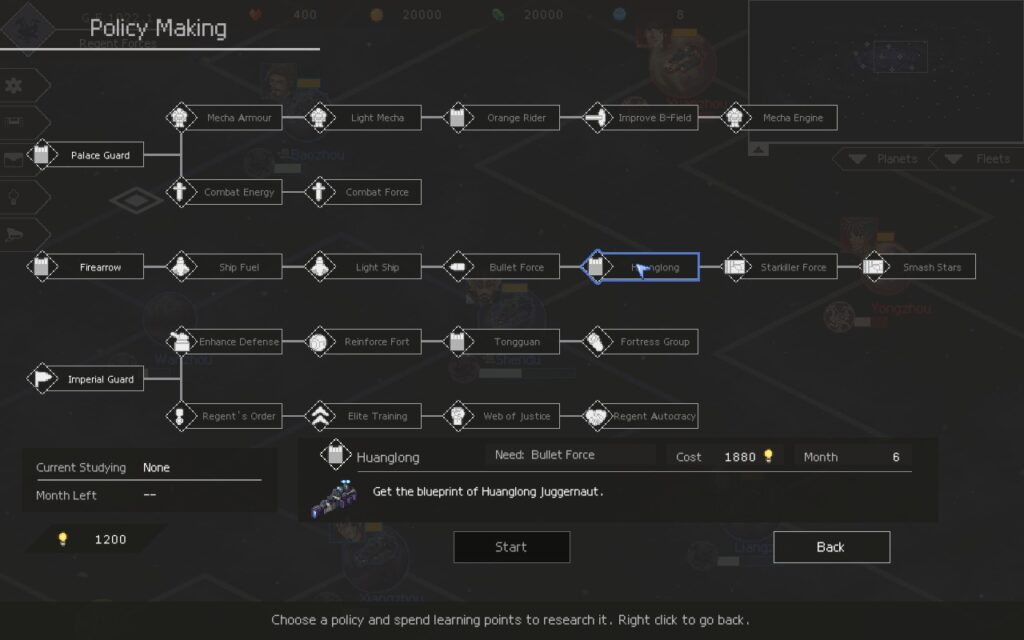
Chaos Galaxy 2 is clearly an iteration on the original. That might be a turn-off for some (who might consider its new features more of an “improvement patch” or DLC) but at the relatively low price point I think it’s a reasonable sell. Where the first Galaxy started relatively stable, its sequel takes place a few years later in a much less stable scenario: two imperial vassal factions are rolled into the two largest factions (Regents and Royalists) in a civil war. The other two are nominally independent (Northsky and Southeaven), though weaker. The fully robotic faction, the Omnics, have conquered all of the star systems their former overlords the Mozi order controlled (Mozi still appears as a minor faction without a home planet). In the far north an estranged imperial navy commander has appeared, who refuses to take a side in the war. In the less consolidated south of the map, a Free Stars faction has appeared (Americana if not America-inspired; its officers include Ben Franklin, Teddy Roosevelt, and Amelia Earhart expys).
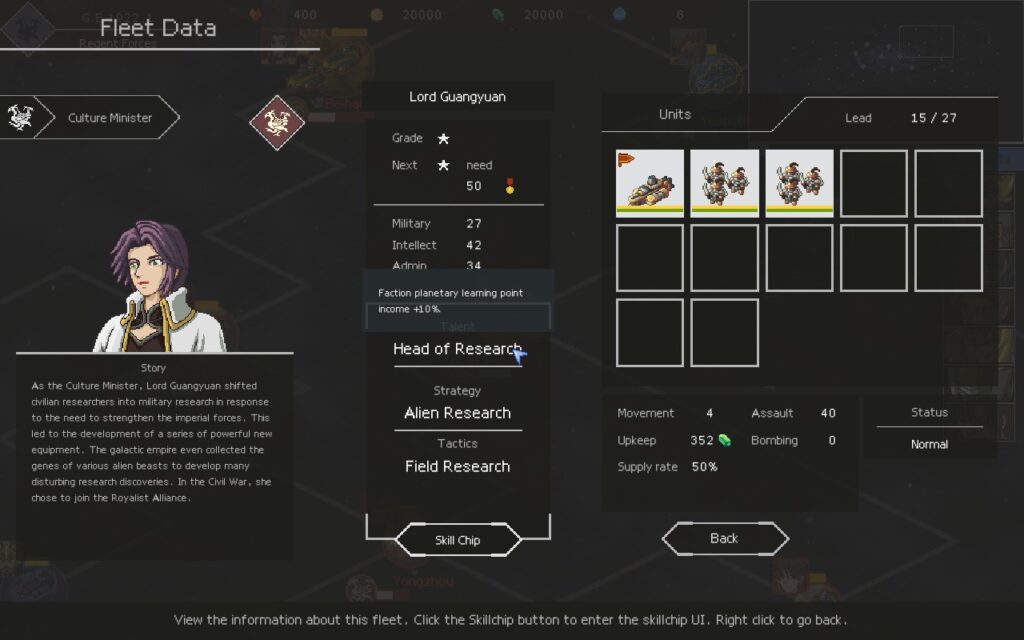
Each major faction type has new features in the strategic layer, making each playthrough a little more interesting. Some of these were in the original in some form, but most are new. Imperial factions have access to appointments to various posts in the Empire to boost their officers. Omnics get a massive amount of research income and can use it to unlock any unit type they have faced off against in battle. Even the smaller factions have their own abilities: Free Stars can incite rebellion using gold, mercenaries and assassins can take on missions for other factions, and so on.
Planet improvements were also changed around. Where before there were relatively simple systems (“bars to fill”, kind of like the first Master of Orion) now planets have building slots that can be filled with several options, and an upgrade point system. Planets still have some unique traits, and some are focused around buildings such as discounts or bonuses to production. This change feels bigger than it really is, though. Once you have more than a few planets built up, it becomes busy-work to put all the buildings in their slots. This system left me feeling that there is something missing. Some sort of adjacency system, or a way for planets to supply other planets with labor points would make things more engaging and allow us to specialize planets more. Thankfully existing building upgrades at least can be automated, so once you have defined the general direction of a planet’s development it can be hands-off.
One option added in campaigns is an alien invasion. The alien faction functionally destroys planets, devouring all life to feed its brood. By default the invasion comes in from the east of the map, where it is likely to gobble up a couple of the smallest independent factions early on. Almost all small factions are at one end of the map or the other, though, so where you want the alien faction to attack from boils down mostly to whether you’d rather take on the challenge early or later. Alien research is available to all factions once they’ve fought aliens, so there are benefits to taking them on earlier. When to take them on is a trade-off: Fighting aliens before having an established economic base is risky, but the alien faction snowballs off of the computer factions (and tends to snowball more quickly than the non-alien factions do).
One of the more annoying aspects of the first Chaos Galaxy is diplomacy – in particular, there isn’t any way to affect relationships of factions with each other. This makes “winning as a vassal” (which theoretically is a goal of several factions) nearly impossible, because you cannot influence your overlord’s diplomacy. Chaos Galaxy 2 offers an “alienate” / rumor-spreading diplomatic option, which is only effective if your relations with the target are decent. It may be too powerful, and it is practically necessary to use early as some factions. The Regents faction in particular is prone to vassalizing other factions quickly if you do not try to befriend independents and rally them against Regents. If a faction snowballs and builds up vassals too quickly, your only option is to befriend that faction and then alienate it against its own vassals (which seems like a strategy that should be possible, but not as easy as it can be in Chaos Galaxy 2).
When compared to other strategy games, Chaos Galaxy 2 might seem rather barebones. I’d argue though that Grand Strategy games often get too hung up on deep mechanics or role-play systems, and don’t focus on the fundamental “macros” of the game. While CG2 has some issues, its core is relatively strong. If I had more time, I would love to dive into a few more campaigns. As it is, though, it is a bit too slow for me to enjoy for long.