Mid-2026 Update
Writing has felt difficult lately. I think this is partly because I have been playing a less compelling-to-write-about set of games, skewing more towards indie and older ones. Sorry, this is going to be a bit of a “brief reviews of things I’ve been playing” post. I’ll start with the older games and move on to (slightly) newer ones.
Kessen 2 (PS2): Probably one of the strangest games I own, Kessen is an odd fantasy-opera take on Romance of the Three Kingdoms, throwing in new characters, completely reimagining existing ones, and mixing action elements into an otherwise real-time-with-pause strategy game. It also has strategy-level decisions as well as tactical ones before battles. I don’t think it’s particularly good, though – while other games are more than the sum of their parts, Kessen 2 has very little actual fun packed into all of its mechanics. Things feel surprisingly dry for a game that is intentionally dramatic, and oddly rigid for a game which clearly has detail under the hood (formations, unit types, general stats, etc).
Warhammer: Shadow of the Horned Rat (PS1): Compelling for all its difficulty, Shadow of the Horned Rat is a frantic real-time strategy RPG set in the old Warhammer Fantasy universe. You play as a mercenary company, picking jobs and trying to make money while gradually getting wrapped up in greater problems. You start with two small companies – cavalry and infantry – and gradually acquire archers, wizards, potentially artillery, etc. While it’s polished in some ways for its time (in terms of artwork, story, and voice acting) its mechanics are opaque and often unfair, giving it a kind of “old school hard” feel. It is possible and perhaps even easy to get “stuck” in the campaign, as reinforcements are restricted and money can get tight. Several branches in the campaign are intentional dead-ends, while others offer different units or outcomes later on. I do think many modern games mistake being perfectly balanced for being fun. A game can be hard and still fun (like this one), or easy and still fun. Hidden items exist in most battles, too, and cannot be transferred between units. Many of these items are situational, but some are generally useful. While there are fewer decisions to be made between battles than Kessen 2, it feels much more satisfying in-battle and the plot is considerably more bearable. The dialogue and music mesh together really well to make battles feel very dynamic, as your various troop commanders yell “Charge!”, “Fire!”, “Engage!”, or enemies cackle as they join the fray.
I actually am a bit surprised I have never written about Shadow of the Horned Rat here as it’s a game I’ve picked up several times over the decades; I’ve never beaten the campaign and only once made it to Loren (a destination hinted at as early as a few hours in). I’ve mostly played the PS1 version but also picked up the PC version to compare a bit. On the whole I think the PS1 version is better – overall it plays a little easier even if the controls aren’t quite as nice. Dark Omen, its sequel, is one of the last PS1 games I bought.
Valkyria Chronicles (PC): I picked this back up recently and it ticks practically all the boxes I have: lots of menus, detailed world with lots to follow in the plot, anti-war story, fun characters, but I somehow managed to drop this again right after beating an annoying boss fight. Early on it is a lot of fun, but there are back-to-back scenarios that restrict your decisions considerably and weigh the game down. However unlike the above games, Valkyria Chronicles’ difficulty mostly feels random. Often if a battle is hard, it is because there are key details in a battle that aren’t given to you ahead of time. This can be for a good reason, but that doesn’t make it feel any more fair.
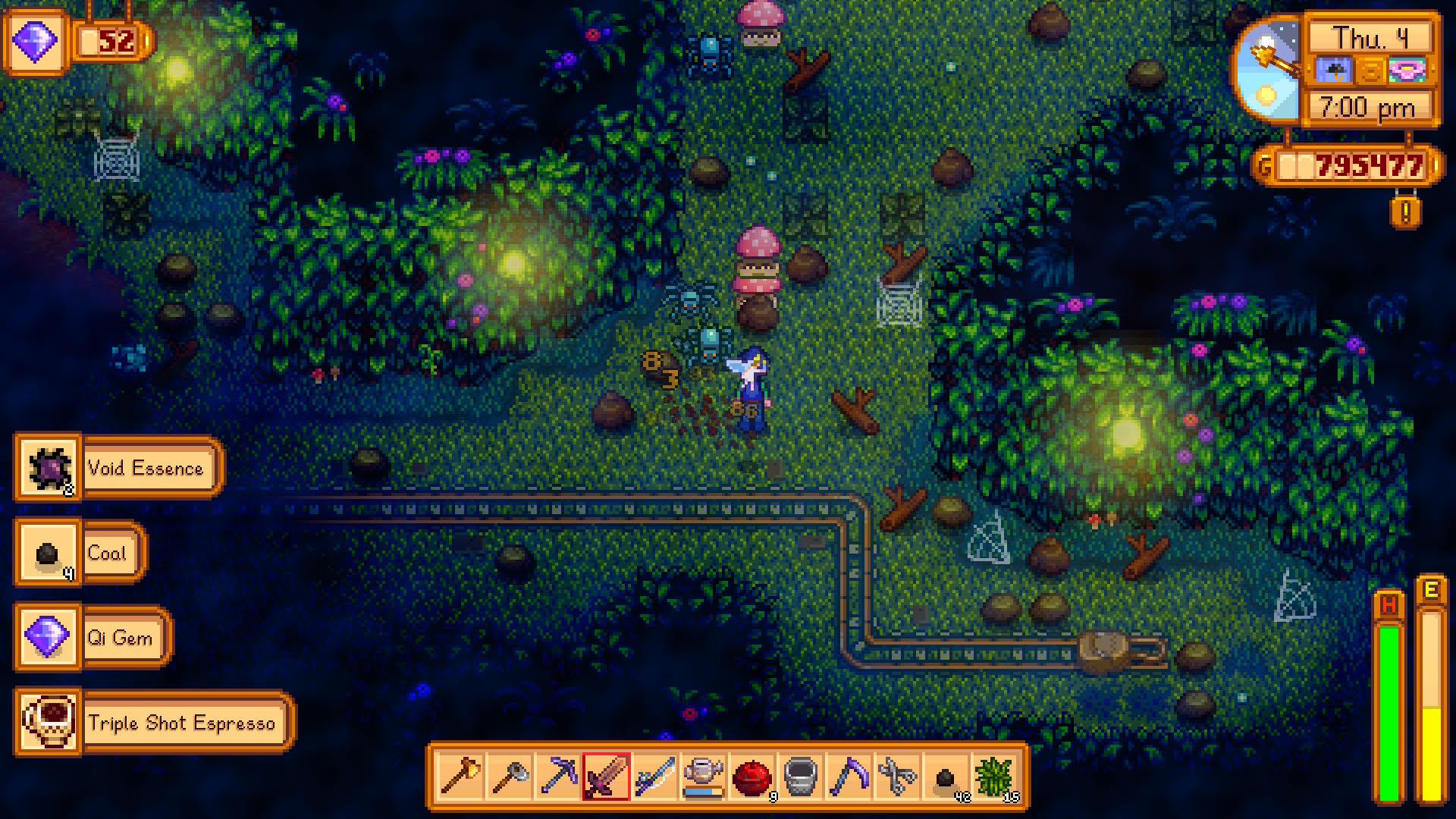
Stardew Valley (Switch): I have finally reached Stardew’s endgame after over a decade (though much of that endgame didn’t exist until 2020). It’s hard to fully describe how Stardew Valley is engaging where Rune Factory isn’t but I may try in the future. Stardew feels like it has a focus that many other modern farming games lack. To be fair, though, I haven’t tried Kynseed, Harvestella, or Tales of Mistria.
People of Note: This is a recent indie JRPG that offers a musical fantasy world, vibrant characters, and classic JRPG-style puzzles. It is also full of music-related puns, so if that is (or isn’t) your jam, that might be a deal maker / breaker. It’s fun, reasonably well-balanced, has some fun strategic skill systems without being overwhelming, and is prett well-written. I enjoyed my time with it, but wouldn’t consider it a must-play. At the same time, it’s in a great “bite sized” JRPG window of 15-20 hours.
Beyond Galaxyland: This is another recent(ish) indie JRPG in a sci-fi setting. However, I felt it was more derivative and less interesting than People of Note. While both share a few things, like motion-based puzzles, a bit of platforming, and core JRPG concepts, Beyond Galaxyland just doesn’t feel particularly new. The summon system seems like it could have promise, but the restriction on SP removes the incentive to use it much of the time. I ended up losing interest about 6 hours in.